
- Certaldo: two towns in one
- The House of Giovanni Boccaccio
- The Palazzo Pretorio and the medieval centre
- The flavours of Certaldo: Boccaccio's onion
- How to Get There from Hotel La Magione
- Conclusion
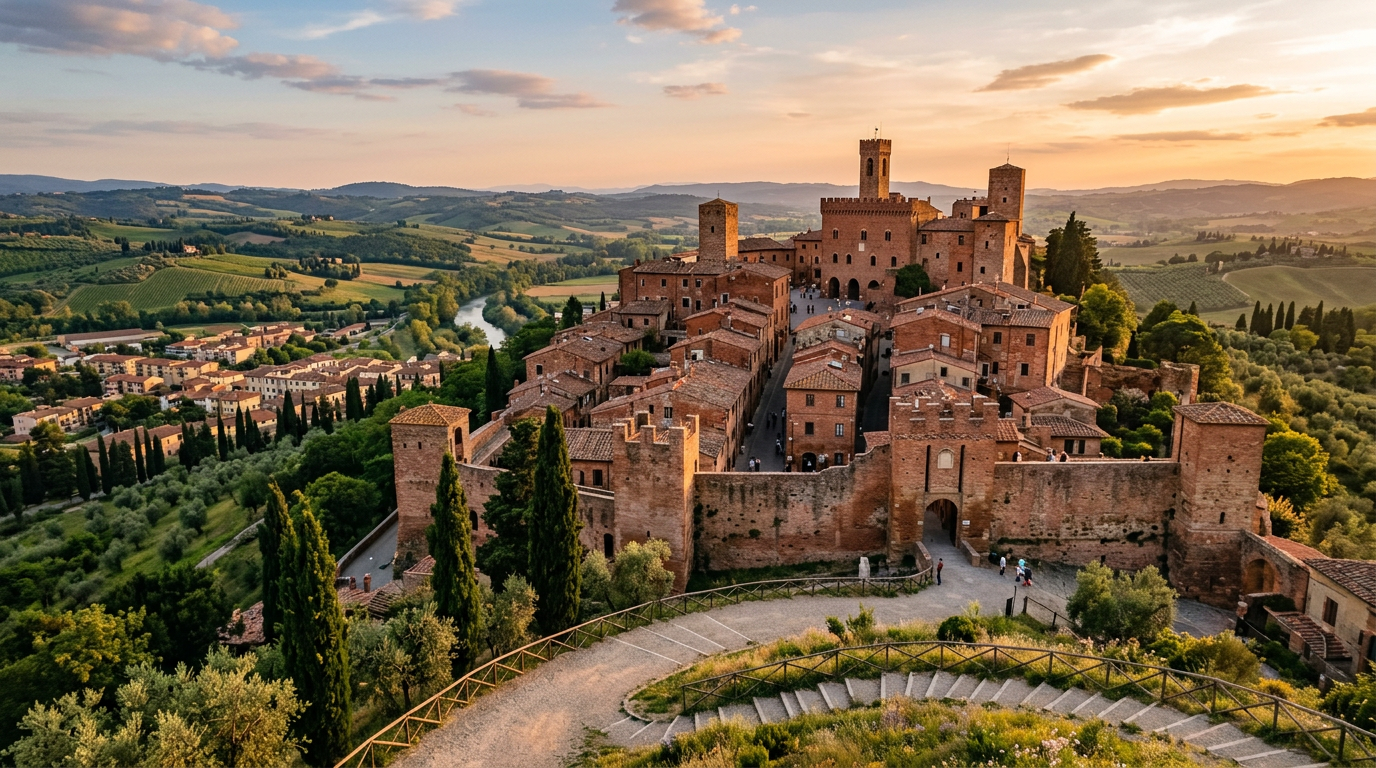
Just ten minutes from Poggibonsi hides a medieval village that few people know well but everyone should visit. Certaldo is the birthplace of Giovanni Boccaccio, author of the Decameron, and preserves a historic centre of red brick that is intact and moving, climbing the Val d'Elsa hillside like a poem written in terracotta. It is one of those places you discover almost by chance and can never quite forget.
The proximity to Poggibonsi makes Certaldo one of the most effortless and rewarding day trips you can make from the heart of Tuscany.
Certaldo: two towns in one
Certaldo is divided into two parts: Certaldo Basso, the modern town at the foot of the hill, and Certaldo Alto, the medieval borgo at the summit. A funicular (or a fifteen-minute walk) connects the two levels.
Certaldo Alto is a small medieval gem: just a few hundred metres long, red-brick walls, ancient buildings, towers and silent alleys. There are no queues, none of San Gimignano's crowds: just real and forgotten Tuscany, to be savoured slowly.
The House of Giovanni Boccaccio
Giovanni Boccaccio (1313-1375), author of the Decameron, lived for a long time in Certaldo, where he died and was buried. The Casa di Boccaccio, rebuilt after the Second World War bombings, today houses a museum dedicated to the author with manuscripts, rare editions of the Decameron and study materials.
Boccaccio's tomb is in the church of Santi Michele e Jacopo, opposite the house. A commemorative inscription records the words written by Coluccio Salutati: a moved and fitting tribute to the father of Italian narrative prose.
The Palazzo Pretorio and the medieval centre
The Palazzo Pretorio of Certaldo is the medieval civic palace of the village, decorated with the coats of arms of the noble families who governed it over the centuries. Its rooms with medieval frescoes and the restored prison cells tell the public and judicial life of the borgo.
Via Boccaccio, the main street of the upper borgo, is lined with medieval brick buildings with Gothic arches and loggias creating a perspective that is beautiful and almost cinematic. In summer the Mercantia international street theatre festival takes place here: a scenographically perfect backdrop for one of Tuscany's finest celebrations.The flavours of Certaldo: Boccaccio's onion
The Cipolla di Certaldo, a Slow Food Presidium, is one of the area's gastronomic highlights. Red, sweet and delicately flavoured, it is called "Boccaccio's onion" because the great author cited it as one of the territory's typical products. You find it in local markets and in some area restaurants, prepared in dozens of ways: in soup, sweet and sour, with cheese.
The local wine, produced in the countryside between Certaldo and Chianti, is another reason to linger at the table and savour the peasant generosity of this land.
How to Get There from Hotel La Magione
From Hotel La Magione in Poggibonsi, Certaldo is just 10 minutes by car along the SR429. It can also be reached by train (Certaldo station on the Empoli-Siena line). The proximity is extraordinary: you can visit the borgo in a morning and combine it with San Gimignano in the afternoon.
Conclusion
Certaldo is Tuscany without artifice. An authentic medieval village, the living memory of Boccaccio, the red bricks of the Val d'Elsa glowing in the setting sun: a place you carry in your heart. If you are looking for an experience far from tourist crowds, Certaldo is the right answer.
Ready to experience Tuscany?Hotel La Magione is your perfect base.
Book your stayand let yourself be captivated by Tuscan magic.