
- The Palio di Siena: what it is and why it matters
- Dates and how to follow the trial runs
- How to watch: stands, balconies and the open piazza
- Experiencing the Palio tradition off season
- How to Get There from Hotel La Magione
- Conclusion
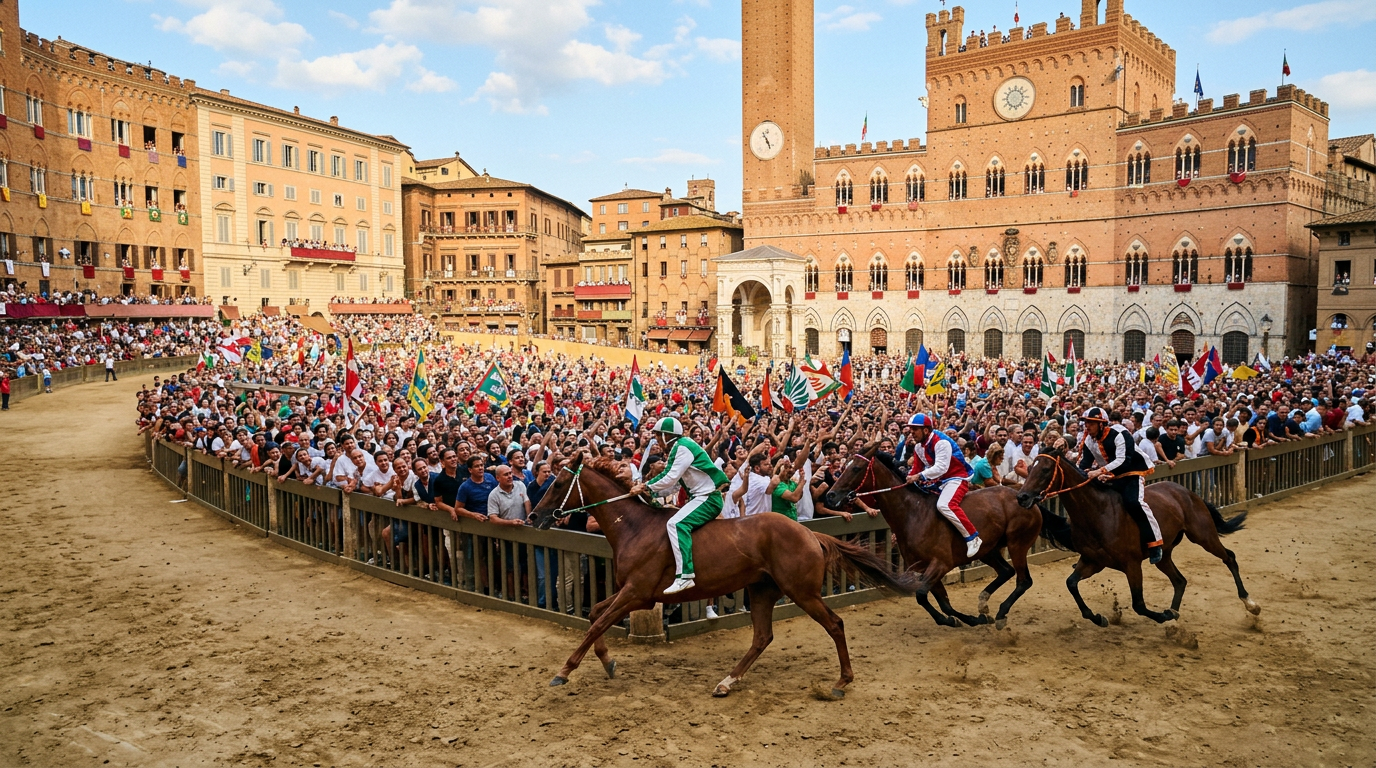
The Palio di Siena is one of the most emotionally charged and authentic historical events in the world. It is not spectacle. It is not tourism. It is a centuries-old and visceral ritual that every year on 2 July and 16 August transforms Piazza del Campo into a vibrating medieval arena, where seventeen contrade compete in a horse race lasting less than two minutes but carrying the weight of centuries of history, passion and civic identity.
Those who have witnessed the Palio even once describe it as an experience that changes the way they see Siena and Italy. The emotional intensity is unlike anything else in the world.
The Palio di Siena: what it is and why it matters
The Palio has ancient roots, documented at least since the 13th century, though in its current form it has been celebrated since the 17th century. The seventeen contrade of Siena (Aquila, Chiocciola, Onda, Pantera, Selva, Civetta, Leocorno, Nicchio, Torre, Valdimontone, Bruco, Drago, Giraffa, Istrice, Lupa, Oca, Tartuca) identify deeply with their historic neighbourhoods, their colours and their symbolic animal.
Of these seventeen, only ten race each Palio: seven by right earned from the previous year, three drawn by lot. The horse is assigned by lot to each contrada the day before the race. The jockey riding the horse is called the Fantino, and his courage means everything.
Dates and how to follow the trial runs
The Palio of 2 July is dedicated to the Madonna of Provenzano. The Palio of 16 August honours the Assumption of Mary. But the week before each race is almost equally intense: the morning and evening trial runs in Piazza del Campo are open to the public and allow you to experience the Palio atmosphere in a more intimate and uncrowded way.
The official trials take place in the evenings before the race. In the final days, the atmosphere in the city is electric and feverish: the contrade prepare, drums resound through the alleys, banners fly from every window.
How to watch: stands, balconies and the open piazza
Watching the Palio requires organisation. The stands overlooking the square must be booked months in advance through the contrade or authorised agencies: the cost is significant but the experience is incomparable. Private balconies on the palazzi are even more exclusive and are booked through the buildings themselves.
The alternative is to stand in the open piazza: entry is free from the morning, you press into the crowd, you experience the Palio in close physical contact with thousands of Sienese. It is an intense and all-consuming experience, but you must be prepared: you cannot move for hours, it is hot, and you need to arrive before dawn.
Experiencing the Palio tradition off season
Not visiting during Palio season? Siena still offers ways to approach this unique tradition. The Museo del Palio in Piazza del Campo tells the history of the race with relics, drappelloni (the painted banner that is the race prize) and historical footage. The museums of the individual contrade, open by appointment, are mines of history and passion.
How to Get There from Hotel La Magione
From Hotel La Magione in Poggibonsi, Siena is just 30 minutes by car. On Palio days, public transport from Poggibonsi is the most sensible choice: traffic around Siena is intense. The hotel is the ideal base for experiencing the Palio and returning to a tranquil and restful environment after the adrenaline of the day.
Conclusion
The Palio di Siena is an experience you never forget. It is not an event to watch: it is an event to feel, deep inside. The crowd breathing, the drums beating, the horses leaping and the entire city erupting in a collective roar: it is human life in its most passionate and unfiltered form. At least once in a lifetime.
Ready to experience Tuscany?Hotel La Magione is your perfect base.
Book your stayand let yourself be captivated by Tuscan magic.