
- Who was San Lucchese: the patron of Poggibonsi
- The Basilica of San Lucchese: architecture and art
- The frescoes of Bartolo di Fredi
- The cloister and convent gardens
- How to Get There from Hotel La Magione
- Conclusion
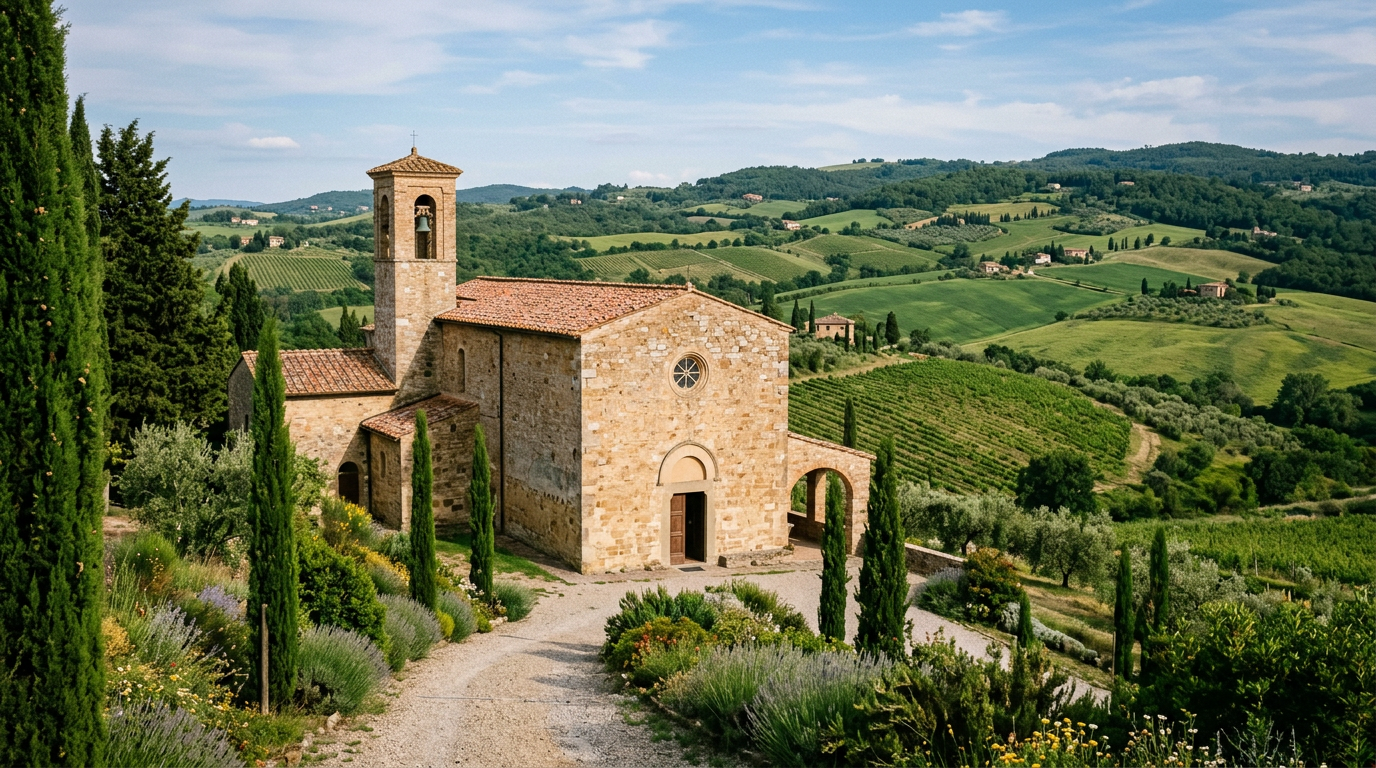
On the outskirts of Poggibonsi, nestled among the green Sienese hills, hides one of Tuscany's least-known medieval jewels. The Basilica of San Lucchese is a place of profound peace and unpretentious beauty: a 13th-century Franciscan abbey housing frescoes of extraordinary artistic value, a silent cloister and a story of holiness that still moves visitors today.
The basilica is just a few minutes from Hotel La Magione and represents one of the most surprising and unexpected discoveries our guests can make during their stay.
Who was San Lucchese: the patron of Poggibonsi
Lucchese Modestini (1181-1260) was a merchant from Poggibonsi who, converted to the Franciscan faith under the inspiration of Saint Francis of Assisi, gave all his possessions to the poor and dedicated his life to charitable works. He was the first Franciscan tertiary in history: the first layman to follow the Rule of the Third Order of St Francis.Beatified in 1273 and venerated as patron of Poggibonsi, Lucchese is a figure of human and concrete holiness, made of everyday gestures: feeding the poor, caring for the sick, welcoming the Via Francigena pilgrims who passed through these hills.
The Basilica of San Lucchese: architecture and art
The Basilica of San Lucchese was built around 1252, a few years after the blessed man's death. The current building, in Sienese Gothic style, is the result of later enlargements that have harmoniously layered onto the original core. The sandstone facade is simple and austere, in keeping with the Franciscan ideal of poverty.
The interior, with a single nave and transept, has a serene luminosity that invites prayer and contemplation. The walls are covered with frescoes spanning three centuries of Tuscan painting.
The frescoes of Bartolo di Fredi
The basilica's fresco cycle is its true treasure. The most significant portion is attributed to Bartolo di Fredi (1330-1410), the great Sienese painter known for the Old Testament cycle in the Cathedral of San Gimignano. The San Lucchese frescoes depict scenes from the lives of Christ and the Virgin with the narrative force and chromaticism typical of the 14th-century Sienese school.
There are also works by Cenni di Francesco, Taddeo di Bartolo and other Sienese painters: an artistic journey of rare continuity that traces the evolution of Tuscan medieval painting.
The cloister and convent gardens
The 15th-century cloister of the basilica is a place of silent beauty. The stone arcades, the well at the centre, the vegetation growing between the columns: everything contributes to an atmosphere of monastic peace that communicates itself immediately to anyone who enters.
The Franciscan friars who still inhabit the convent maintain a living spiritual presence that is discreet and welcoming. Their simplicity and kindness are an integral part of the experience.
How to Get There from Hotel La Magione
From Hotel La Magione in Poggibonsi, the Basilica of San Lucchese is reachable in just a few minutes by car, or even on foot via the Via Francigena that passes nearby. It is the ideal destination for a morning or late afternoon walk, when the light is softer and the place recovers its monastic quiet.
Conclusion
San Lucchese is Poggibonsi's secret: a medieval basilica with extraordinary frescoes, a silent and meditative cloister, the living memory of a saint who chose simplicity. It is just steps from the hotel. Come, sit in the cloister, breathe in the air of these hills, and let yourself be touched by the beauty of the sacred.
Ready to experience Tuscany?Hotel La Magione is your perfect base.
Book your stayand let yourself be captivated by Tuscan magic.