
- Volterra: three thousand years of history on a rock
- The Guarnacci Etruscan Museum
- The Balze: the landscape at the end of the world
- Alabaster and local craftsmanship
- How to Get There from Hotel La Magione
- Conclusion
Volterra is one of those cities that always surprises you. You see it from a distance: a fortress on a hill, medieval towers, the open Tuscan horizon all around. You approach and feel that this city has something ancient, deep, almost mysterious. It is not an impression: Volterra is one of the best-preserved Etruscan cities in the world, with three thousand years of history emerging from every stone.
Visiting it is a journey through time that is extraordinarily touching and captivating.
Volterra: three thousand years of history on a rock
The Etruscan settlement on this hilltop at 531 metres above sea level dates back at least to the 9th century BC. The Romans called it Volaterrae. In the Middle Ages it became a powerful commune, wealthy thanks to salt and mineral extraction. Today it preserves its medieval structure intact, with the Palazzo dei Priori (1208, the oldest palazzo dei priori in Tuscany), the Cathedral and the Baptistery.
But beneath the medieval city, Etruscan Volterra is still there: in the museum, in the Etruscan gates (Porta all'Arco, dating from the 4th-3rd century BC, still standing), in the necropolises scattered around the walls.
The Guarnacci Etruscan Museum
The Guarnacci Etruscan Museum is one of the most important Etruscan museums in Europe and one of the oldest in Italy (founded in 1761). It holds around 600 alabaster and terracotta funerary urns, coins, jewellery and bronzes. The collection is extraordinarily rich and moving: every urn tells of a deceased person, a story, a fragment of Etruscan daily life.
The most celebrated piece: the "Ombra della Sera" (Evening Shadow), a long, slender votive bronze from the 3rd-4th century BC that Giacometti might have sculpted. There is something profoundly modern and moving about this two-thousand-year-old Etruscan bronze.
The Balze: the landscape at the end of the world
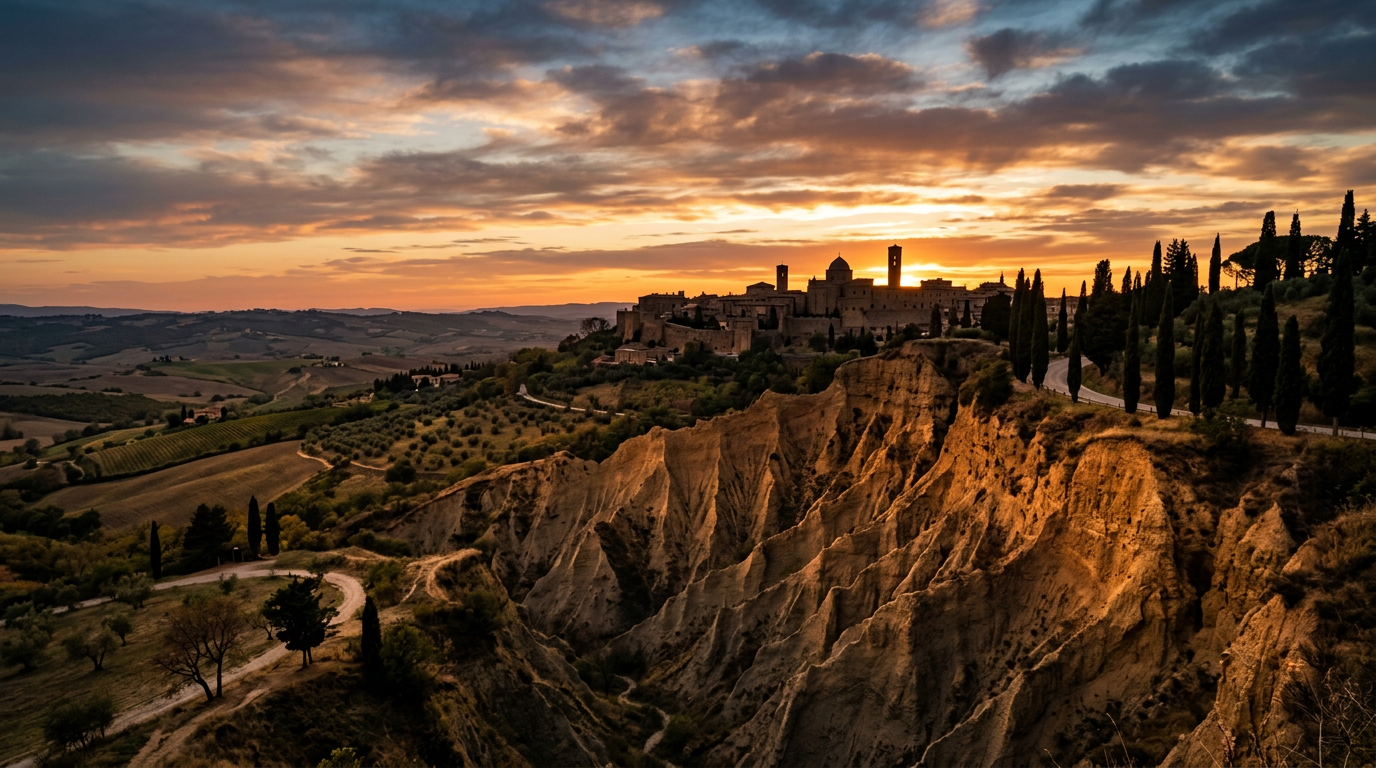
To the west of Volterra, the Balze are a unique geological and visual spectacle: gypsum and sand cliffs eroded by water over millennia, which have swallowed part of the Etruscan necropolis and, in the Middle Ages, an entire abbey. The landscape is lunar and surreal, especially at sunset, when the orange light colours the white clays in a spectacularly unreal way.
A walk to the Balze along the Etruscan walls is almost a meditative act.
Alabaster and local craftsmanship
Volterra is famous for alabaster craftsmanship, a translucent stone worked here for at least two thousand years. The old town shops display alabaster objects of every kind: vases, lamps, sculptures, decorative objects. Many craftspeople still work by hand, using techniques passed down through generations.
Taking home an alabaster piece from Volterra means taking home a piece of vibrant and irreplaceable history and craftsmanship.
How to Get There from Hotel La Magione
From Hotel La Magione in Poggibonsi, Volterra is about 35 km away, reachable in approximately 40 minutes. The scenic road through the metalliferous hills is beautiful. A day in Volterra is more than enough to see the best, but if time allows, a stop at a local trattoria for pici with wild boar is absolutely compulsory.
Conclusion
Volterra is a city that does not shout its beauty: it whispers it. You must stop, listen, touch the stones of the Etruscan walls, get lost in the medieval alleys, watch the sunset over the Balze. It is a more austere and wild Tuscany, but profoundly authentic and unforgettable.
Ready to experience Tuscany?Hotel La Magione is your perfect base.
Book your stayand let yourself be captivated by Tuscan magic.