
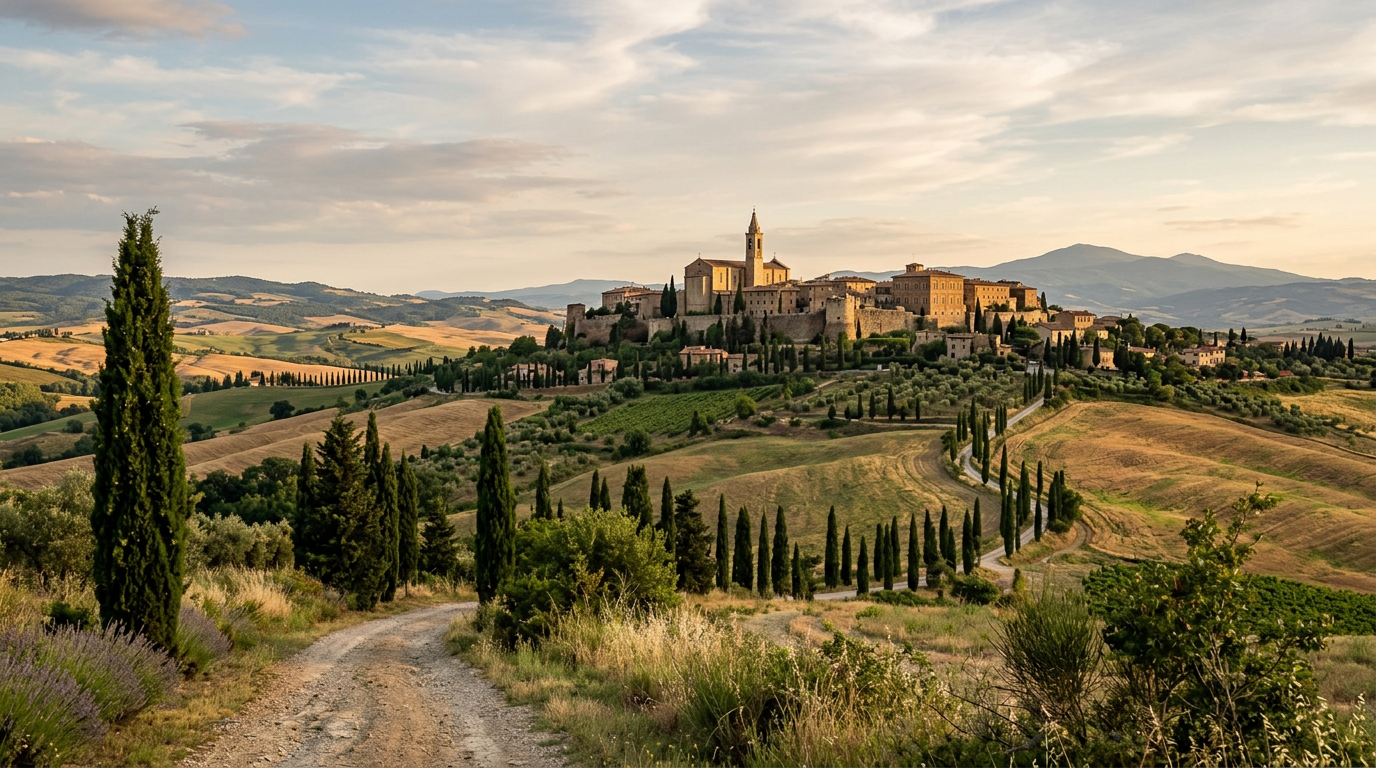
- Pienza: Pope Pius II's ideal city
- Piazza Pio II and the Cathedral
- The garden of Palazzo Piccolomini and the view over the Val d'Orcia
- Pecorino di Pienza: a gastronomic treasure
- How to Get There from Hotel La Magione
- Conclusion
Pienza is a utopian experiment that worked. In 1459, Pope Pius II decided to transform his birthplace into an ideal Renaissance city: proportioned squares, harmonious palazzi, a luminous cathedral, a garden that looks out onto the infinity of the Val d'Orcia. Knowing what to see in Pienza means understanding how an architectural dream became reality, and how that reality has remained intact for five centuries.
A UNESCO World Heritage Site since 1996, Pienza is one of the unmissable stops on any itinerary through southern Tuscany, easily reachable from Poggibonsi in about an hour.
Pienza: Pope Pius II's ideal city
Pope Pius II, born Enea Silvio Piccolomini in Corsignano in 1405, entrusted in 1459 to architect Bernardo Rossellino the task of rebuilding his birthplace according to Renaissance urban planning principles. The result is a historic centre of rare coherence and beauty: every building is in dialogue with the others, every perspective is calculated, every space has an almost musical proportion.
The central nucleus can be walked in a few dozen minutes, but you could spend hours watching how the light changes on the travertine facades, how the shadows shift across the cobblestones, how the village breathes.
Piazza Pio II and the Cathedral
Piazza Pio II is considered one of the finest Renaissance squares in Europe. The Cathedral, Palazzo Piccolomini, the Bishop's Palace and the Palazzo Comunale face each other in extraordinarily harmonious balance. Not a single element is out of place.The Cathedral of Pienza, with its travertine facade and bright interior in German Gothic style (Pius II had lived in Germany), holds altarpieces by Giovanni di Paolo and other Sienese masters. The light filtering through the large windows creates an atmosphere that is collected and almost celestial.
The garden of Palazzo Piccolomini and the view over the Val d'Orcia
Palazzo Piccolomini is one of the masterpieces of Italian Renaissance architecture. The guided tour includes the papal apartments, with original 15th-century furnishings, and above all the hanging garden overlooking the Val d'Orcia.From that garden, the view is something beyond words: the hills of the Val d'Orcia gently succeed each other to the horizon, with Monte Amiata in the background. It is the finest view in Pienza, and perhaps one of the finest in all of Tuscany.
Pecorino di Pienza: a gastronomic treasure
Pienza is the capital of Tuscan Pecorino cheese. This sheep's milk cheese, produced on the surrounding farms using traditional methods, is found in every little shop in the village in dozens of varieties: fresh, aged, matured in walnut leaves, in ash, under oil. The scent of freshly cut Pecorino is utterly irresistible.The delicatessens along Via Rossellino and throughout the historic centre are a compulsory pilgrimage. Paired with a glass of Brunello, Pecorino di Pienza is pure Tuscan joy.
How to Get There from Hotel La Magione
From Hotel La Magione in Poggibonsi, Pienza is about an hour by car, following the SS2 towards Siena and then the SP146 into the Val d'Orcia. It combines perfectly with Montalcino (20 minutes away) and Bagno Vignoni (15 minutes away) for an exceptionally rich day in the Val d'Orcia.
Conclusion
Pienza is a place that stops time. Strolling through its alleys, sitting on the terrace with its view over the Val d'Orcia, tasting Pecorino in an ancient shop: you feel part of something greater. It is Tuscany at its most perfect and dreamlike.
Ready to experience Tuscany?Hotel La Magione is your perfect base.
Book your stayand let yourself be captivated by Tuscan magic.